Medical and dental office
Exam rooms, labs, operatories and waiting areas all want different temperatures at different times, and the practice next door is not on your schedule. Zone-level control without a VAV box per room.
 Mechanical
Services
Mechanical
Services
Variable refrigerant flow gives you a system that modulates instead of cycling, and zone-by-zone control without a duct chase in every wall. It also punishes bad installation and bad commissioning harder than any other equipment class. We install and service VRF for commercial buildings across Central Texas.
A variable refrigerant flow system runs one or more inverter-driven outdoor condensing units and pipes refrigerant — not chilled water, not conditioned air — to a set of indoor fan coil units spread through the building. Each indoor unit takes only the refrigerant it needs at that moment, and the outdoor compressor speeds up or slows down to match the total. Nothing is staged on and off at full tilt.
That single design decision is where every VRF advantage comes from. A conventional rooftop unit has two or three capacity steps, so on a mild morning it cycles: full output, satisfied, off, drift, full output again. A VRF system holds a steady partial output instead. Buildings spend the overwhelming majority of their operating hours at part load, which is exactly where a modulating system separates itself from a staged one.
The second advantage is zoning. Every indoor unit is individually controlled, so a corner conference room, a server closet and an interior open-plan area are three genuinely independent zones without VAV boxes, reheat coils or a duct main large enough to serve all of them. On heat recovery systems, some zones can be cooling while others are heating on the same refrigerant loop, and the heat pulled out of one is moved into the other rather than rejected outdoors.
The third is physical. Refrigerant lines are small. A building where running full-size ductwork means dropping ceilings, cutting a historic facade or losing leasable square footage is often a building where VRF is the only option that does not compromise the space.
VRF is not a better system than everything else. It is a better system for specific buildings, and these are the ones we see it win on in Central Texas.
Exam rooms, labs, operatories and waiting areas all want different temperatures at different times, and the practice next door is not on your schedule. Zone-level control without a VAV box per room.
Each suite gets its own control and its own runtime, which makes both comfort complaints and utility allocation far easier to deal with than one shared rooftop unit and a thermostat war.
Downtown Austin and Georgetown buildings where there is no room for duct mains, no roof structure for a large unit, and a facade you are not allowed to cut into.
Per-room control, quiet indoor units, and no through-wall PTAC punched into every guest room. Occupancy varies constantly, which is the load profile VRF handles best.
Dining room, bar and back of house on separate zones, with the kitchen exhaust and make-up air handled conventionally alongside it.
A dedicated indoor unit that runs year round on the same system as the rest of the floor, instead of a separate mini-split nobody maintains until it fails.
Design and install through service, repair and scheduled maintenance — commercial and industrial only.
VRF costs more to install than a comparable conventional system. It is more equipment, more refrigerant piping, more control wiring and considerably more labor. On a simple single-tenant building with an open floor plan and a roof that will take a packaged unit, a rooftop unit is usually the better buy and we will say so rather than sell you the more expensive option.
VRF is also less forgiving. Refrigerant line length, vertical lift between outdoor and indoor units, and charge accuracy all sit inside manufacturer limits, and a system installed outside those limits will run — badly — for years while nobody can explain why one end of the building never gets comfortable. Small rooms served by a large refrigerant charge also have to be checked against refrigerant concentration limits, which is a calculation, not an opinion.
Service is genuinely different work too. Diagnostics are manufacturer-specific and largely electronic, parts are proprietary rather than off the shelf, and a technician who is excellent on packaged equipment is not automatically competent on a VRF system. That is the practical risk of owning one, and the reason it matters who you hand it to.
We would rather have this conversation before a system is bought than be the company that inherits it. If you are weighing VRF against a conventional system, tell us the building and the use and we will give you the case for both.
Every air-cooled system loses capacity as ambient temperature climbs, and VRF is no exception. A system selected against a mild design day will hold a room fine in April and fall behind in August. Selection here has to be made against real Austin design conditions, with the outdoor unit’s high-ambient performance curve in hand rather than its nominal tonnage on a spec sheet.
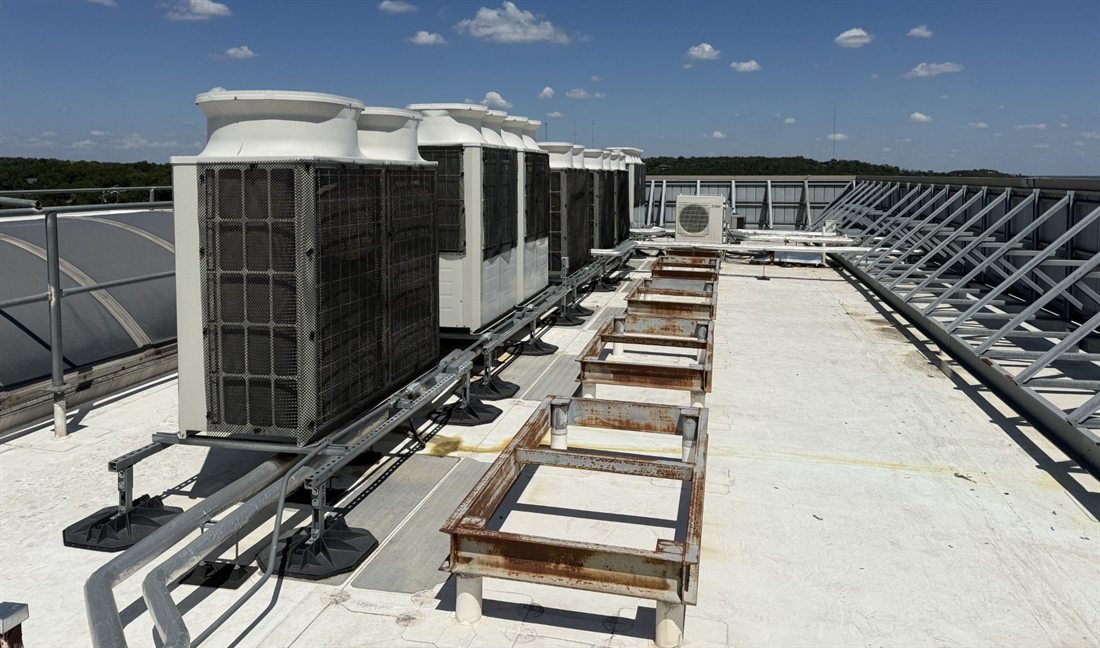
Placement matters as much as selection. VRF condensers sit on hot roofs, often in a tight row, and they reject heat into each other when clearance is short or a parapet traps the air. We see systems that run acceptably in spring and trip on high pressure every July purely because of where the units were set and how close together they are.
Maintenance is where Texas dust and pollen show up. Condenser coils load up, static rises, head pressure climbs and efficiency quietly disappears well before anything faults. On the indoor side, our humidity means condensate is constant and a blocked drain in a ceiling cassette becomes a ceiling tile problem rather than an HVAC problem. Both are cheap to prevent on a scheduled maintenance program and expensive to ignore.
Heat recovery deserves a realistic note as well. Simultaneous heating and cooling happens less here than in a northern climate, so the payback on a 3-pipe system is thinner than the brochure math suggests — but interior zones needing cooling while perimeter offices need heat is a real year-round condition in Austin office buildings, and on the right floor plate it still pencils out.
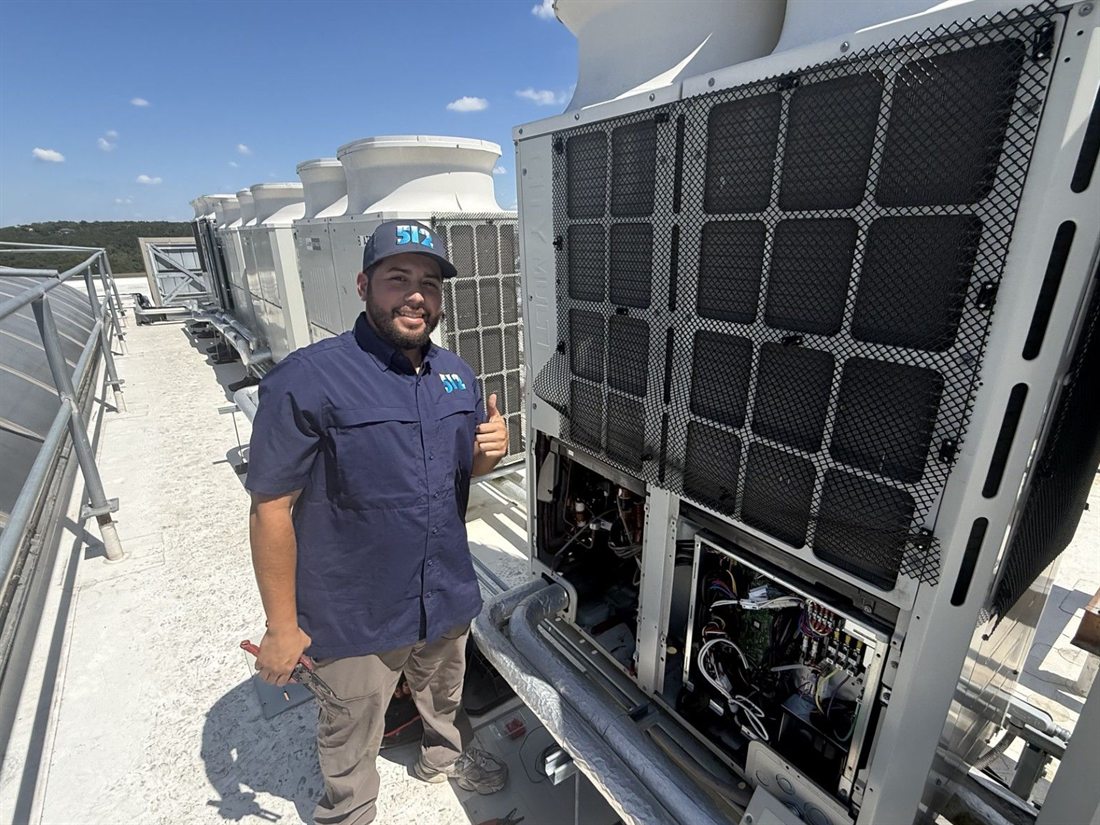
We calculate the load against the actual intended use and lay out zones around how the space is really occupied — not one indoor unit per room because that is how the plan was drawn.
Equipment picked on high-ambient performance, line length and lift, with refrigerant concentration checked for the small rooms. You get the numbers, not just a model number.
Piping brazed under nitrogen, pressure tested, evacuated to spec and charged by weight. Control wiring and addressing documented as it is installed rather than reconstructed later.
Every indoor unit verified under load, controls proven, and a closeout package with the as-built addressing, charge record and test results. That package is what makes the system serviceable in five years.
A large share of our VRF calls are not new installations. They are buildings with a system somebody else put in, a fault code nobody has interpreted, missing commissioning paperwork, and a facility manager who has been told twice that the whole thing needs replacing.
Usually it does not. What it needs is someone to read the system as a system: verify the actual charge against line length rather than guessing, check the addressing against what the controller thinks is out there, look for the leak instead of topping it off again, and confirm the outdoor units are not cooking each other on the roof. Most of the systems we are asked to condemn come back with a repair and a documented baseline instead.
If a system genuinely is beyond economical repair, you will get that answer with the readings behind it — the same way we handle any commercial HVAC repair or chiller decision. And if it is failing at the worst possible moment, emergency service runs 24/7.
VRF installation, service and repair across the Austin metro — including the medical office and multi-tenant suite growth in Cedar Park, Round Rock and Georgetown.
VRF is variable refrigerant flow. A ductless mini-split is essentially the small, simple version of the same idea — one outdoor unit serving one or a few indoor heads. A commercial VRF system scales that up: larger inverter-driven outdoor units, many indoor units on a shared refrigerant loop, branch distribution, central controls and often heat recovery so some zones can heat while others cool. Same operating principle, very different engineering and commissioning requirements.
Usually yes, but how much depends entirely on the building. The savings come from running at part load instead of cycling, and from only conditioning the zones that are occupied — so a building with varied occupancy and many small zones sees a real difference, while a single open space that runs at full load all day sees much less. Anyone quoting you a fixed percentage without looking at your load profile is guessing. We would rather run the numbers on your building.
Both. We handle design and equipment selection, full installation, conventional-to-VRF retrofits, commissioning and the closeout documentation, plus ongoing service and repair on systems regardless of who installed them. We work the major commercial VRF manufacturers and do not charge more because another contractor put the system in.
Equipment lead time is almost always the longest pole, and on VRF it can be substantial, so the honest answer starts with when the equipment can be ordered. Once material is on site, the refrigerant piping and control wiring take longer than an equivalent conventional install because there is simply more of both. For finish-out work we push to identify and release long-lead equipment as early as the selection allows — see tenant finish-out HVAC for how we schedule that.
Often it was never commissioned correctly rather than broken. The usual culprits are charge that does not match the actual installed line length, indoor units addressed differently than the controller believes, a small refrigerant leak that has been topped off instead of found, or outdoor units set too close together and recirculating hot air. All four produce exactly that symptom, and all four are findable. We start by verifying the system against its own design rather than replacing parts.
Yes, and it is a common move — keeping the packaged equipment where it works well and adding VRF for the zones it serves badly, such as a new suite, a conference wing, a server room or an addition with no duct path. Mixed systems are normal in commercial buildings. The thing to get right is the control strategy, so the two systems are not fighting each other at the boundary between them.
Send us the building, the zones and what you are trying to solve. If VRF is the right answer we will tell you why. If a conventional system serves you better for less money, we will tell you that instead.
Emergency commercial HVAC and chiller response across Austin and Central Texas — nights, weekends and holidays.